In the heart of Taipei stands a century-old industrial facility that once faced the prospect of demolition—formerly known among railway workers as the “Train Hospital.” Today, the site reopens to the public as Phase One of the National Railway Museum Park. When undertaking this project, our foremost consideration was how this former center of maintenance and repair might be reactivated in a manner that is both authentic and faithful to its original purpose.
Archicake design was responsible for the overall exhibition planning and design of the diesel–electric workshop. During our initial site visit to the S212 exhibition zone with the Zuidesign team, we encountered an S212 diesel railcar with its engine casing opened. The removal of the exterior allows visitors rare access to the train’s internal mechanical components—elements that are typically concealed from view. However, the processes by which kinetic energy is generated, transmitted, and transformed within this complex system remain largely abstract and difficult for general audiences to comprehend.
This prompted a central curatorial question: as the S212 diesel railcar and the armature exhibition area become key focal points within the park, how might the previously unseen journey of energy be translated into an unmanned theatrical experience—one that renders these processes both intelligible and perceptible to visitors?

The Invisible Journey of Energy: The S212 Diesel Railcar
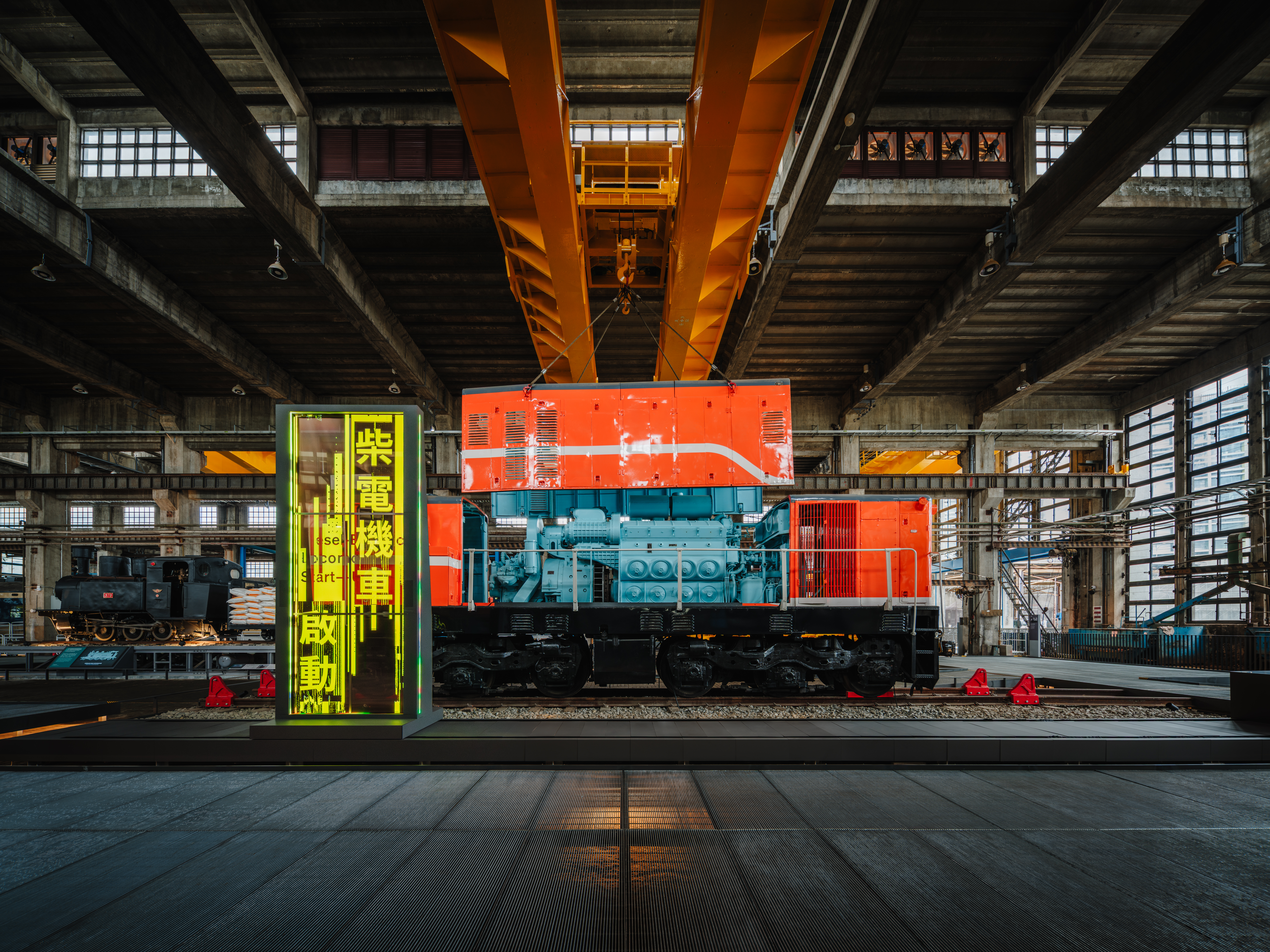

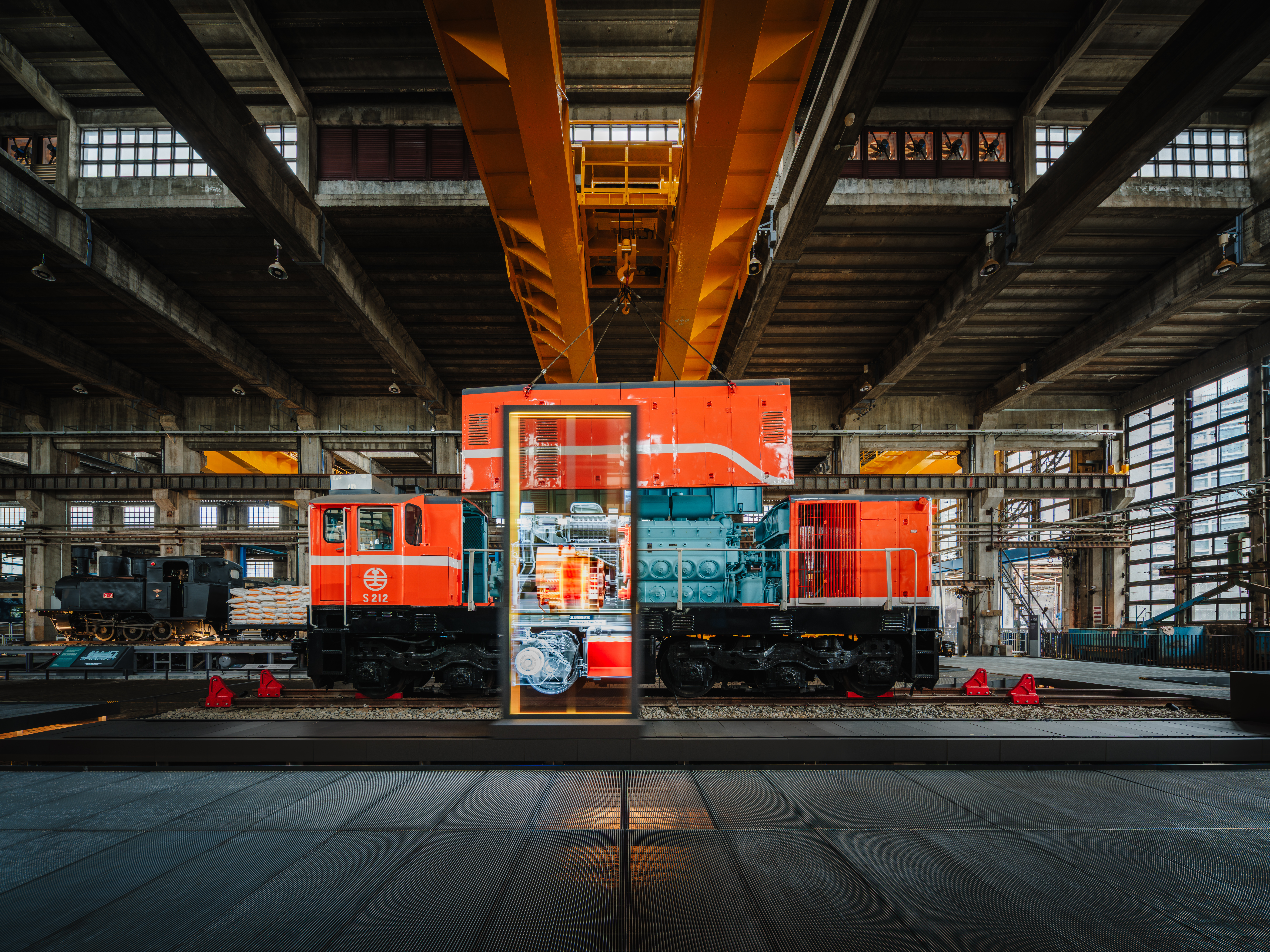
Through exhibition strategies of “deconstruction” and “translation,” the S212 diesel railcar enables visitors to comprehend the systems of energy transformation that are invisible to the naked eye yet fundamental to the operation of the factory as a whole. A large transparent screen is positioned in front of the physical machinery, where animated visuals simulate how electrical input is transmitted through the internal systems of the railcar and ultimately converted into the kinetic energy that propels the train forward.
Resembling an X-ray scanning device, the transparent screen allows viewers to observe the animated energy flows while simultaneously maintaining a clear view of the actual machinery behind it. This layered presentation establishes an intuitive correspondence between the direction of energy flow and the spatial configuration of the mechanical components, enabling visitors to connect abstract processes with tangible structures.
A Dance of Steel and Current: Cranes and Armatures at Work
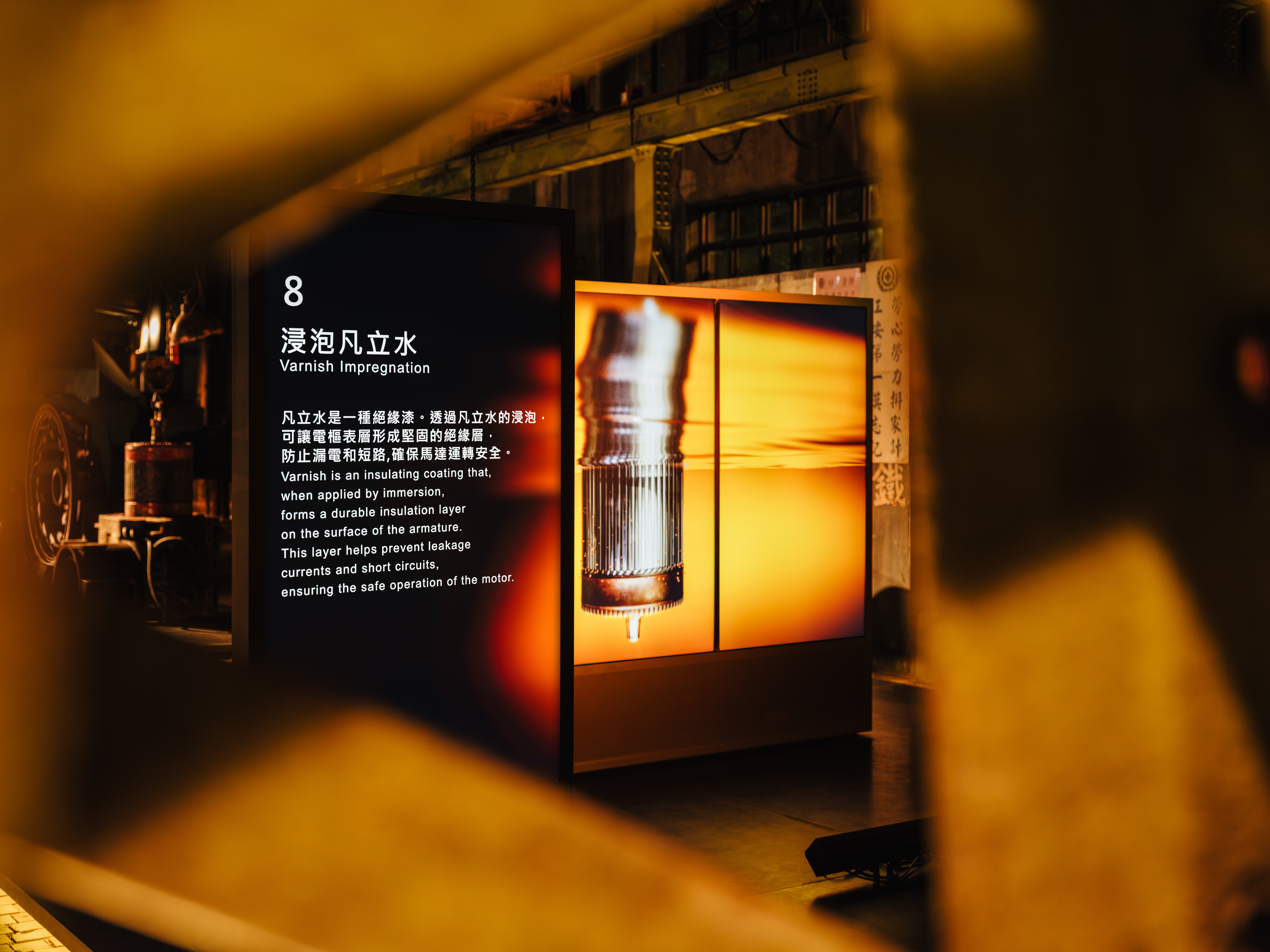
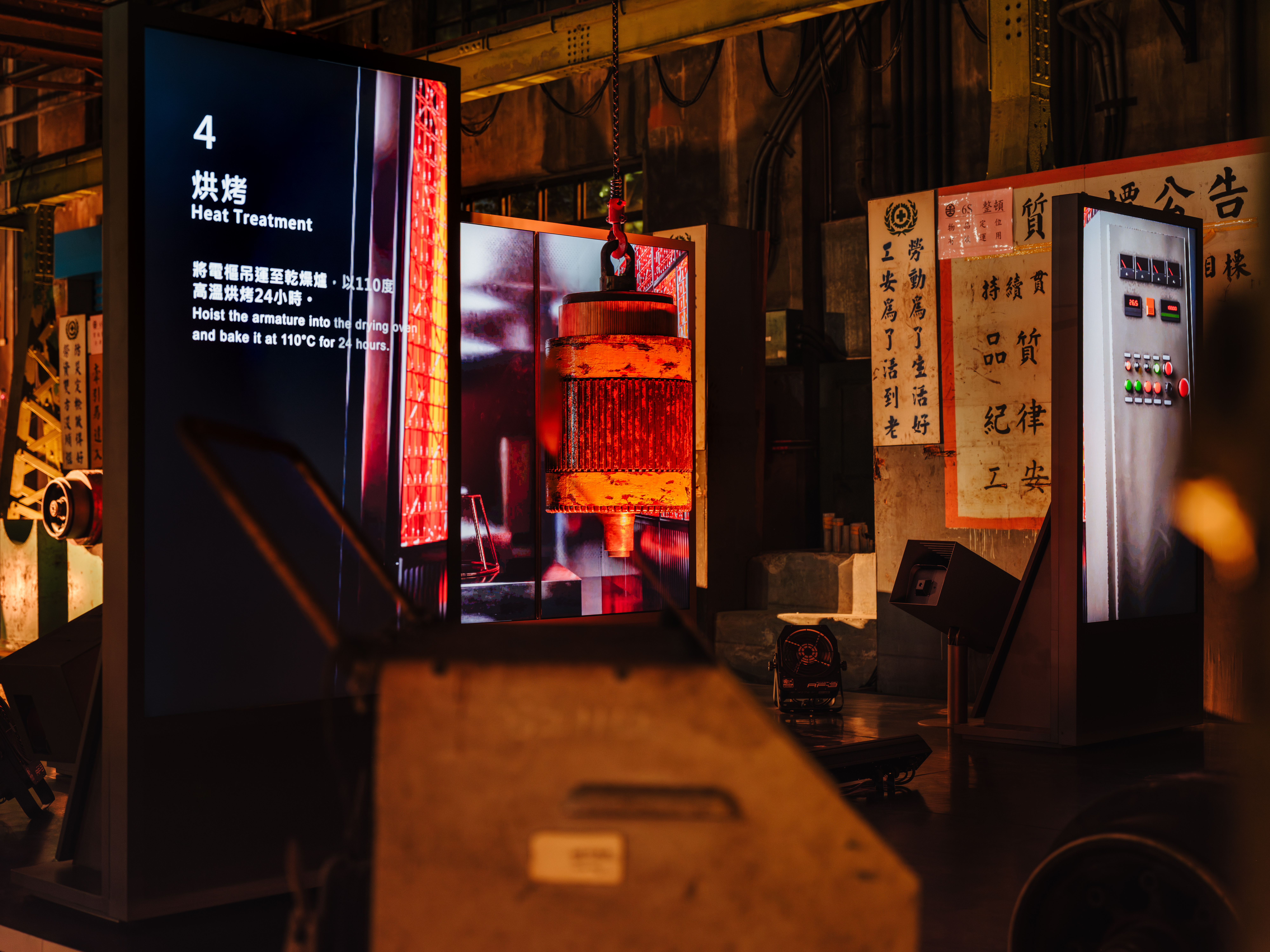
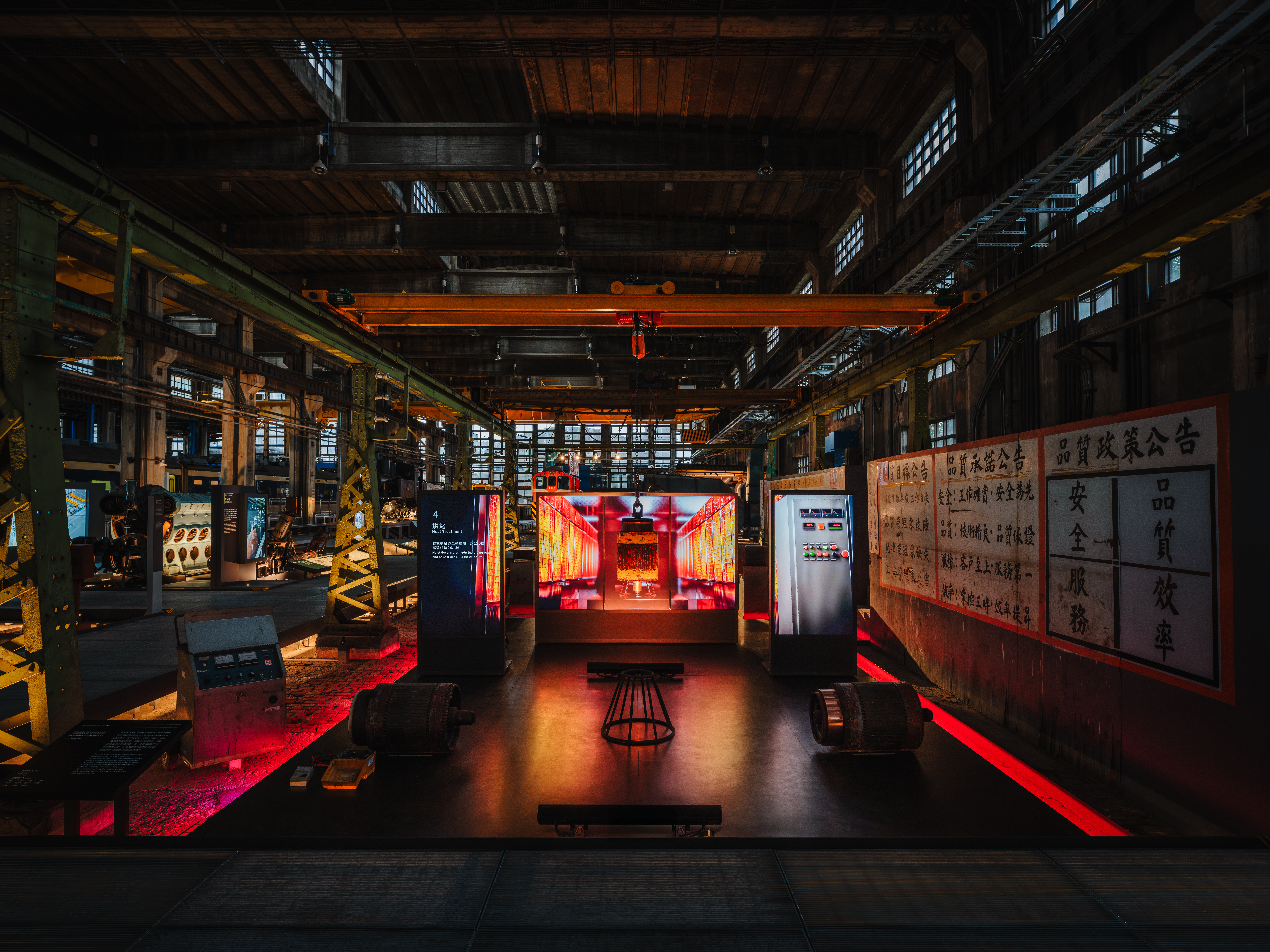
Armature maintenance constitutes one of the central themes of this exhibition. The gallery features a full-scale armature model weighing approximately 60 kilograms—one-fifth the weight of the original—accompanied by animated sequences that deconstruct the maintenance process. Key procedures, including disassembly, inspection, immersion, and drying, are presented step by step. The pacing of the animation follows the actual operational workflow, with visual content precisely aligned to the physical model, highlighting the strict requirements for accuracy and sequencing inherent in the maintenance process.
Another key feature of this section is the transformation of the overhead crane’s movement paths into an integral part of the exhibition. Animated imagery is synchronized with the crane’s operation, recreating historical scenes of the crane traversing the workshop and lifting armatures. To accurately convey the trajectories of both the crane and the armature, multiple full-scale simulations were conducted, involving the physical handling of the armature to rehearse its movement. Much like blocking rehearsals in theatre, these preparations allow the armature and crane to assume the role of performers, staging a dynamic presentation within the factory space. The overhead crane functions as an invisible thread, seamlessly linking the movements and operations of the various machines throughout the workshop.
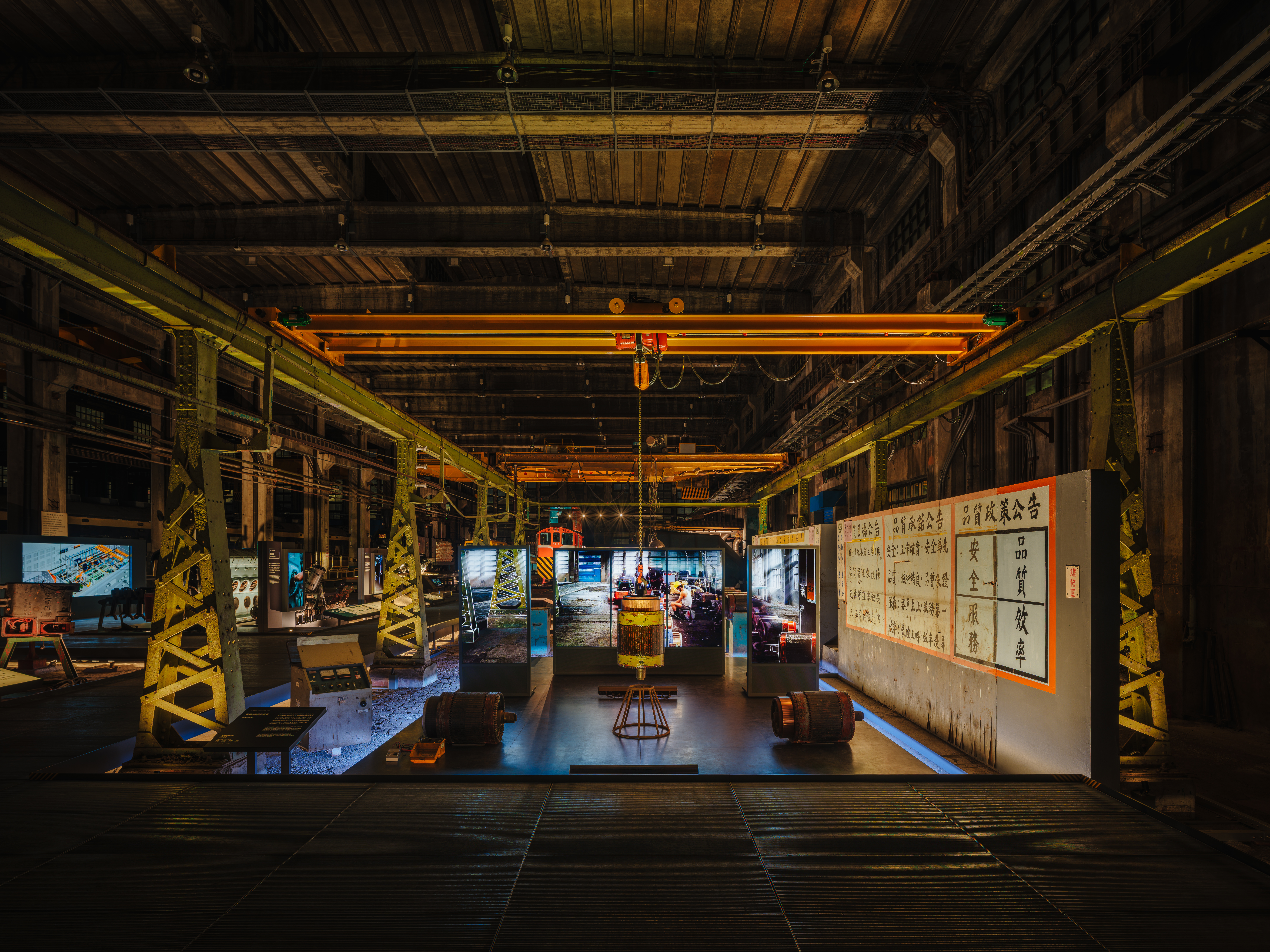
The Workshop as Stage, Operation as Script
When machinery assumes the role of performer and space is transformed into a stage, the railway workshop becomes an industrial theatre in motion, where machines enact the processes of operation. No longer positioned as external observers, visitors follow the designated circulation paths into the heart of the workshop itself. Within its monumental scale, they trace the working trajectories formed by interwoven mechanical movements.
Energy transformations once concealed within the machinery, the cyclical motion of the overhead crane, and the rhythms of daily maintenance are re-presented through exhibition and interpretive translation. Together, they form a vivid performance—one without human actors, yet animated by the continuous operation of the machines themselves.
Special Thanks
National Railway Museum、archicake design、Fugang Vehicle Depot Railway Maintenance Technicians
主辦單位 Organizer |國家鐵道博物館 National Railway Museum
策展與設計單位 Exhibition Organizer |築點設計 archicake
數位體驗設計 Digital Experience Design|當若科技藝術 IF Plus
創意總監Creative Director|王伯宇 Po-Yu Wang
專案執行統籌 Executive Coordination | 葉靜怡 Rita Yeh、鄭頴之 Gigi Cheng
前期企劃及資料統整 Initial Planning & Data Compilation |黃香綺 Kiki Huang、蕭家葦 Ariel Hsiao
影像記錄 Media Documentation|定影影像工作室 FIXER Photographic Studio
S212 Diesel-Electric
導演 Director|陳思伶 Ssu-Ling Chen
視覺設計暨影像動態|光渦制所 LIGHT VORTEX LIMITED COMPANY
美術設計 Art Designer|陳思伶 Ssu-Ling Chen、 谷宣萱 Hsuan Ku
動畫製作 3D Animation|黃顯光 Hao-Kuang Huang
視覺特效合成 Compositing|王震寧 Chen-Ning Wang
程式開發設計 Programming Design|王伯宇 Po-Yu Wang 、李承瑾 Jin Lee 、陳力瑋 David Chen
音樂設計 Music Design|周家光 KaKong
Armature Maintenance
導演 Director|陳思伶 Ssu-Ling Chen
視覺設計Visual Design|光渦制所 LIGHT VORTEX LIMITED COMPANY
美術設計 Art Designer|陳思伶 Ssu-Ling Chen、谷宣萱 Hsuan Ku
動畫製作 3D Animation|目子拾參 Muzixiii Studio
動態腳本Motion board|張偉廷 Aaron Chang
程式開發設計 Programming Design |王伯宇 Po-Yu Wang
硬體工程 Network Engineering|黃韜云 Bernie Huang